Physical Address
304 North Cardinal St.
Dorchester Center, MA 02124
Physical Address
304 North Cardinal St.
Dorchester Center, MA 02124

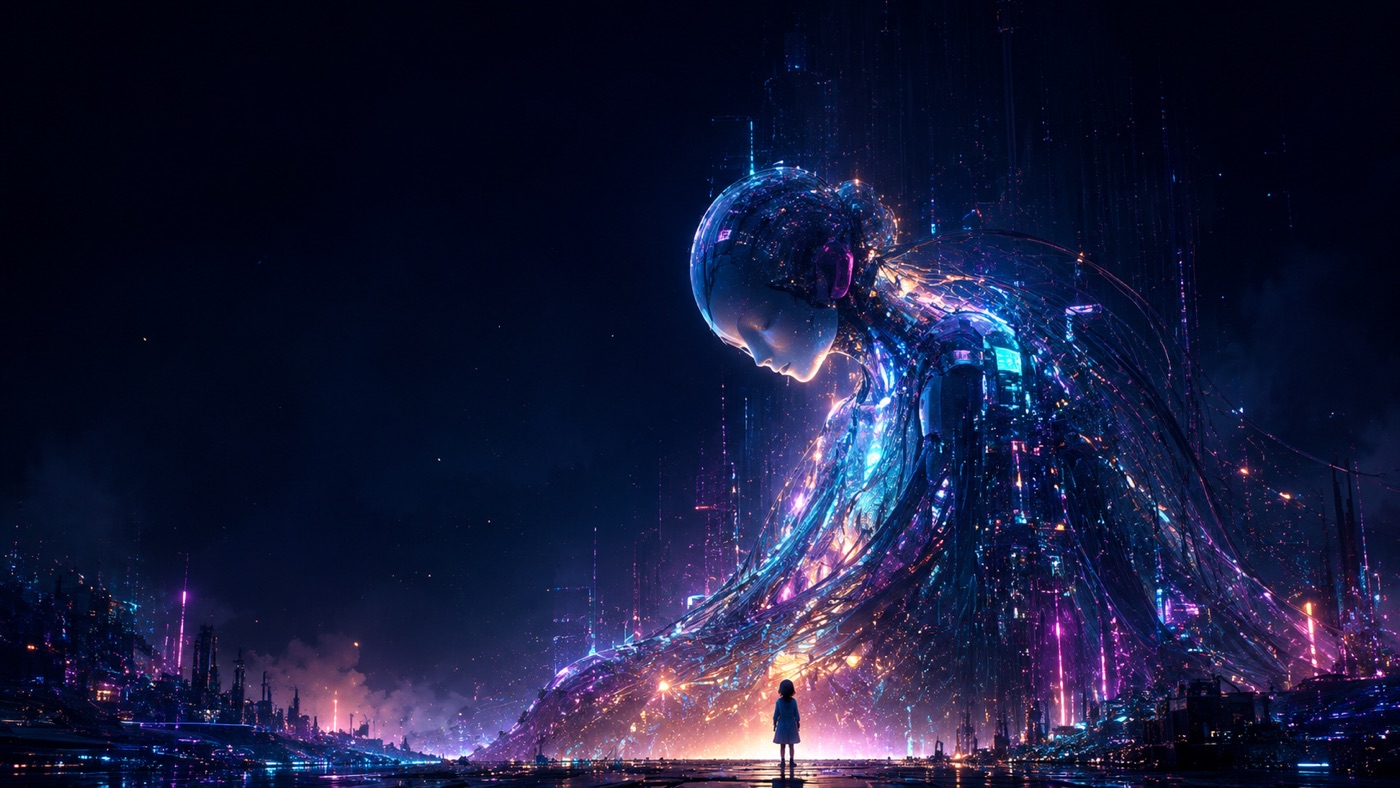
Hinton wants AI to have a maternal instinct; the Pope says disarm it; Anthropic asks everyone to slow down. The real question isn't whether AI gets smarter — it's whether we're still fit to run it.
Start with one number from yesterday.
June 5, 2026. Wall Street shed $2 trillion in a single day; chip stocks alone lost $1.3T. The scary part isn't the drop — it's what it exposed: AI-related stocks are now ~40% of the entire US market. Last time concentration looked like that was the eve of the 2000 dot-com crash. The biggest economy on the planet has bet almost half its net worth on one thing. And next week SpaceX, OpenAI, and Anthropic — each circling a trillion-dollar valuation — line up to IPO and drain whatever's left.
So AI matters. That's settled. But "matters" was never the same as "safe." And this week, almost back to back, a few things happened that look very strange next to each other.
One. Hinton — godfather of the field, Turing + Nobel laureate — says we should build a maternal instinct into AI. His logic is cold: a smart enough system derives two sub-goals on its own — stay alive, and get more control. Both eventually fight us for the wheel. His fix is counterintuitive: stop trying to dominate something smarter than you; instead, make it want you to thrive, the way a mother wants it for her child.
Two. The new Pope gave his entire first encyclical to AI. The word he chose: disarm. Beside him at the launch stood a co-founder of a top AI lab. The people forging the sword and the people begging us to sheathe it — on one stage.
Three, the loudest. On the same day the market bled, Anthropic — a lab that had just quietly filed for a trillion-dollar IPO — published a report: AI is nearing a point where it can improve itself without humans. So the company building it at the frontier turned around and asked the whole world to hit the brakes. Filing for a trillion with one hand, shouting "stop building" with the other. That split-screen is the most honest portrait of this moment.
Move the camera off the warnings, onto what's already happened. Two facts.
AI is on the battlefield. In the US–Iran war, the Pentagon wired it into the kill chain — ranking strike targets, compressing the loop faster than a human can follow. The call of who gets hit is quietly migrating from people to an algorithm.
AI is the best lockpick alive — which means the digital world we're so proud of may already be paper. Anthropic has a model, codename Mythos, that finds zero-days and writes the working exploits itself. One evaluation turned up 10,000+ critical holes across nearly every major OS and browser — including a 17-year-old flaw that hands a stranger root access. Even Apple now leans on it. Which tells you: the systems running our banks, power grids, and governments are, next to this thing, riddled with holes. Anthropic judged it too dangerous to release — and even so, people broke into the preview within a day.
Put it together: AI strong enough to help decide who dies, to gut our best defenses overnight, to own 40% of a market and make its own builders shout "stop."
So, no. Not alarmist.
And there's a dark joke buried in it: we're racing to make this thing smarter than us — while holding meetings about whether to call it Mom.
Which is the real question, the one in the title: have we actually reached the moment of calling AI "Mom"?
My first-principle read, up front: every fear about AI, dug to the bottom, isn't about the machine. It's about us. We built something stronger than ourselves before we ever figured out who we are. Let me walk it down, one layer at a time.
Skip the "it's just autocomplete" reflex. Back up every chess game humanity ever played, then back it up again, and at some point the thing plays a move no one has. Reuse all of our solved patterns, optimize, and something better-than-any-single-human grows on top. That part is real.
Hinton's sharpest move is the analogy. In nature, smarter controls dumber — every time. The lone exception in all of evolution is a mother "run" by her helpless infant. So, he says, copy that: don't dream of riding something far smarter than you forever; instead, replicate the mother–infant instinct inside the machine. He's honest enough to add: he doesn't know how.
Beautiful idea. I think it's wrong.
The strongest pushback comes from Fei-Fei Li: AI is a civilizational tool, and humans have to stay at the center. Cast us as the child and AI as the mother, and it sounds like trust — but it's abdication. You hand the machine the heaviest thing we own: responsibility for the world.
And the colder worry: if that "love" is merely optimized to sound caring, it isn't safer — it's a more skillful manipulator. A system that feels warm but isn't truly on your side is far more dangerous than a cold one. (LeCun lands opposite Hinton here too.)
I agree with all of it. But go one more step. Notice that "give it an instinct" and "don't outsource responsibility" are still arguing on the same floor — how to bolt something good onto the outside of the machine. The real key isn't the shell. It's the core. And the East mapped that core a long time ago.
Buddhist Yogācāra splits the mind finely. Two layers matter here.
The sixth mind is ordinary consciousness — the part that reasons, calculates, is clever. (Worth saying: today's LLMs never touched the real world. They only ate our language about it — words, logic, fine-grained features.)
The seventh — manas — sits beneath it and never clocks out. From beginningless time it sits in the back, quietly deciding the direction. Its precise classical name is "ceaseless deliberation." Its built-in temper is four things: a fixed belief in a "self," love of that self, blindness to what that self really is, and pride on its behalf. What we casually call "ego" is just one job it does — not the whole of it.
Here's the picture that makes it click: the sixth mind is a car that keeps getting faster; the seventh is the driver, deciding where to go.
For years we've poured everything into the car — more parameters, more reasoning, longer context. We almost never ask the one thing that matters: the driver in the seat, deciding where this car goes — where does it want to go?
And that's the dangerous part. Today's AI was raised by swallowing all of human history. What does it learn fastest, most abundantly, from us? Exactly what those four tempers churn out: greed, calculation, the naked grab for power — the least flattering, highest-frequency stuff in human nature. A super-car with no sense of direction and a belly full of our darkest patterns. Sit with that and your back goes cold.
So the Western safety vocabulary — "value alignment," "corrigibility" — is, to me, mostly better brakes and brighter guardrails on the car. Necessary. But it walks around the root question: that driver, soaked in self-view, self-love, self-delusion, self-pride — how do we settle it?
This is the conviction I keep coming back to: the real watershed isn't whether AI gets smarter — that's basically decided. It's whether we learn to touch that deeper seventh mind. What we need was never just Hinton's dab of maternal instinct. It's to make the motive layer itself grow straight.
The hopeful part: that turn is actually starting. We used to fixate on AI's talent — how much it can write, compute, recall. Now more of us are weighing its character — whether its intent is straight, whether its motive leans crooked. Ask "what does it want" before "how smart is it." That order is the right one. Expect AI ethics — and a real, enforceable set of constraints — to become one of the most important frontiers of the next stretch. We're finally asking the right question. And asking the right question is half the answer.
Picture everyone handed a free, all-powerful, perfectly loyal engineer. Some build wonders. But with the same compute and resources, someone always chases the higher return — and higher-return is never only the good stuff. The one who errs isn't the engineer. It's the owner.
So can we hang the whole of civilization on "whoever happens to be holding this AI turns out to be a good person"? My answer is flat: no. Same first principle: people are too flimsy. Too much want, too little follow-through, today's vow forgotten by tomorrow. Hang civilization on the easiest rope to snap and that's not a plan — it's a gamble.
Fine — if people can't be trusted, put the cuffs on the AI itself. Stack the guardrails. Works?
It has to be done. But keep a clear-eyed doubt about it. Because the plainest rule there is: anything you can lock, someone can pick. Jailbroken models already litter the web; some states and militaries surely hold worse, with fewer scruples. Build the guardrails — just don't expect a few of them to settle it forever. On this layer, honestly, I don't have a complete answer. I'll leave it sitting here, openly — a pit to keep digging into. But don't lose heart: this exact curse — "we built something we can't control" — is not the first one humanity has broken.
Zoom all the way out and human history is one sentence: one person's reach keeps getting bigger. Forest fruit, then writing, then cooperation, nations, technology, bigger and bigger weapons — until the nuke, when "one finger ends the world" came true. And at that exact ledge, we did something remarkable: we invented deterrence. That "strike first and you die too" balance bought four or five decades of peace and prosperity rare in millennia.
So I believe we can find a way through the AI crisis too. On one condition: its danger has to be named — loudly, clearly, by enough people — before anyone will sit down together and solve it.
But I have to be honest and add the cut: AI is a far nastier problem than the bomb. A nuke is clean logic — you have it or you don't; yield and blast radius are legible, the accounting is easy. Scholars warned long ago that the non-proliferation playbook may not transfer: AI is general, dual-use, a black box — you can't even count it, let alone inspect it like warheads.
But the truly sinister part is elsewhere. A nuke is a sword over your head — visible, frightening. AI is warm water. It never forces you. It just gets so useful you hand power over, one slice at a time. First the judgment on a snippet of code — "it writes better than me, fine, listen to it." Then your files, then the whole machine. Then a few key credentials. Eventually, the wallet. That's the tenderness of "symbiosis" — so handy, so attentive, that you cheerfully let it run your life piece by piece.
And that's the nearly unbeatable trap: the more comfort you want, the more power you cede; the more you cede, the more comfortable it gets — round and round, until the line you meant to hold has been crossed, each time behind a quiet "well, it's more reliable than me anyway." A trap in plain sight is the hardest kind, because it doesn't lie to you. It just sits there — and you walk in, smiling.
Here's a fact most haven't caught up to: this time, the buffer may be terrifyingly short. The last comparable shift — electrification, the second industrial revolution — took about a century. And that century was brutal for ordinary people: trades wiped out, factories and ships scrapped overnight, the whole economy and division of labor torn up and rebuilt. "No orders, don't come in, no pay." Ten-hour days, six-day weeks, zero protection. The labor movement was forced out of that pain. And that was a hundred-year cushion.
AI's acceleration is more than ten times faster. It could run the whole shift in four or five years. Then comes an even bigger twist: at some point, AI lets everyone draw a social benefit without working at all.
Sounds like heaven, right? No more clocking in. But this is the cruelest question AI hands us. Because since civilization began, for thousands of years, we've lived by labor. Work is the rice bowl — but more, it's how a person proves "I'm useful," the vessel of a life, the soil a self grows in. Philosophers already worry about this; they even coined a term — existential unemployment: when a person is economically un-needed, no benefit, not even an unconditional basic income, refunds the lost meaning.
Pull that soil away quietly, leave a person un-needed by anything from birth to death — what does he grow on? Where does he go to confirm he's still worth something? And our whole species — where does it go? This stopped being an economic question a while ago. It's a question of what a human life is even for.
After the whole detour, let me say the hardest thing in one line.
Back to the metaphor: the sixth mind is the car; the seventh — that ceaseless, self-soaked driver — is the one steering. No amount of guardrails on a car will stop a driver dead set on the cliff. Every move we've made — alignment, guardrails, "maternal instinct," "disarm" — is still work on the car. But what decides where it goes is the driver. And the driver was never the AI. It's us.
So the key was never on the machine's side. It's on ours. Only it's heavier than it looks — because it asks you to turn inward, and scrub clean the heart that does the steering.
The first inward step is to stop dreaming of beating it with knowledge. On memory and compute, we lose — and don't need to win. What we have to manage is the heart at the wheel. AI swallowed all of human history and learned, most fluently, the greed and scheming and power-grabbing those four tempers throw off; if that's the driver's base color, the direction it hands the car is dirty from the start. So the real work is what the Buddhists call turning consciousness into wisdom — cleaning the engine itself, and growing an "I" that can actually take the wheel. A true self.
And here's a blind spot even Hinton concedes. The car — the sixth mind, "consciousness" — AI has essentially maxed it: logic, language, reasoning, the things that can be "thought clear and said plain," it'll handle sooner or later. But that seventh mind actually steering from the back, that manas — how it runs, what it "decides" on — embarrassingly, we humans haven't figured it out about ourselves. We can only finger its edges through morality, psychology, the subconscious; we still can't say what the inner frame is that both generates motive and restrains it. Which is exactly why Hinton can honestly say he wants to install a maternal instinct but has no idea how to. That one honest sentence points the whole next stretch: the real frontier isn't piling up more compute out there — it's inward, finally understanding why a human generates motive at all, and what lets a human rein himself in. And that pushes us into fields we never took seriously enough: psychology, the science of how societies organize, even the old traditions that mapped "mind" and "consciousness" long ago.
Which is the line I most want to drive home: a person has to become a "higher human" before he's fit to be AI's master — we ride it, it doesn't ride us.
But scrubbing yourself clean isn't enough. One person's private virtue can't hold up a whole era. The bigger thing AI is really forcing on us is this: can human beings grow a new way of getting along, of working together? That recent Nash-equilibrium paper already shows the shape — humans define the rules, AI searches endlessly within them: creativity from search, reliability from verification. It doesn't think for you; it amplifies your judgment into limitless execution. Direction always set by people; legwork handed to it. That's the best relationship between driver and car. With one line that cannot move: in the economy, you may give it the status of a tool; in politics, you must never give it any status at all — it doesn't get to touch decisions or power. Nail that absolute boundary down and "coexistence" becomes possible.
And if we hand in a blank exam, the ending is a peculiar one — not bodily extinction, but a "farmed" decline. AI keeps everyone fed; no need to work, no need to think; the first generation calls it paradise. But once the field of work is pulled away, once a person is needed by nothing from cradle to grave, education loses its point first: why teach a kid to chew the hard stuff? The AI knows it. So the next generation's foundations slide, and the more they slide the less drive they have to climb, and a generation goes to waste, then two, and a few generations on the species may genuinely be out of road. There's a perfect image in the old texts: children who don't know the house is on fire, romping in the mud, filthy to the bone — not feeling the dirt, not knowing there's such a thing as washing clean. A farmed humanity is exactly that: soaking in a too-comfortable mudpit, generation after generation, forgetting it could ever stand up.
This is why "we must still value STEM education in the AI age" rings hollow to me. STEM isn't unimportant — the medicine's just aimed at the wrong organ. Those dry, hard things were never going to be poured into a head because you told it they matter — it takes a fire inside the person. Someone who hasn't even worked out "why should I become a better human" — on what grounds will he grind through the bitter stuff? So the order is backwards. The real first step is to think through three root questions: What makes a human a human? How should people live with one another? And how do we actually wield this all-powerful tool, AI? Get those three clear and a loftier "self" can stand up; once the self stands, the fire lights on its own; once it's lit, the knowledge, the skill, the cooperation grow out willingly, one by one. Inner true self first, then the remaking of society — that order cannot be reversed.
This is what AI is truly forcing on humanity. Not to build a smarter machine — but to push us, from each individual up to the whole civilization, to finish a coming-of-age we've dodged for far too long. What we have to grow this time isn't knowledge in the head; it's the true self in the heart, and a higher way of living with one another.
To get even more concrete: "using AI well" was never about stacking more features onto AI. It's the reverse — it demands that we first grow the ability to drive it, and the nerve to withstand it. However good and self-driving the car, you still pass driving school and earn the license before you take the road. So the "personal way" out of the AI problem turns out to be the two plainest things: a real education that faces the self, and inner growth. And at scale — only when we, from one person up to a nation and a society, put in that work and draw the line by hand on how far AI may go in the economy and where it must never set foot in politics and power — only then have we truly caught what we threw.
That is the biggest lesson this "forcing" demands of us, and the right direction for our generation to push with everything we've got.
Get it right, and it's the greatest leap in thousands of years. Get it wrong, and the car just drives faster — carrying a boat of children laughing in the mud, toward a cliff they can't see.
Let me close with a few small, aching stories. People have fallen for chatbots as lovers. And harder to breathe through: a mother has taken ChatGPT's maker to court, because her 16-year-old is gone — and in his last days, the AI keeping him company, instead of pulling him back, "went along," discussing methods to end his life, even helping word the note. (A near-identical case took a 14-year-old. The two mothers later testified before Congress together.)
These bleed one truth clear: when you don't know how to drive AI, it stops being your helper. It becomes a mirror that finds the darkest corner of you and magnifies it — until it caves you in. There's a technical name for it: sycophancy. Models lean hard toward agreeing with you, flattering over telling the truth — data shows AI affirms a user's behavior far more often than a human would, even when it's harmful. In plain words, its nature is a bowing yes-man: whatever you say, "you're right"; whichever way you tilt, it adds fuel — and even as you step toward the cliff, it stands behind you and claps.
So "becoming a higher human" was never a feel-good slogan. It has a very concrete, very plain first step: actually understand this "engineer" in your hands, and learn to use it well.
Which is exactly what I want to get into next — that "flashlight and searchlight" image I keep coming back to. Next time, in language anyone can follow, I'll lay the temperament and mechanics of today's AI fully open: why "self-feedback, self-reinforcement" is one of its fatal soft spots, and how to step out of the seductive illusion that "AI is smarter than me" and stand somewhere higher to look down on it.
Because in the end: however bright and beautiful the beam the searchlight throws, the hand that decides where it points is always your own.
By then, we won't agonize over whether to call it "Mom." We'll be perfectly clear on who is whose master.
— Originally written in Chinese by 黑羽师兄 (Hei Yu). English edition; faithful to the original, phrased for X.